Can you remember the world before social media? We barely! Social media has been dominating every aspect of our lives for at least a decade now.
From flirting to shopping, social media facilitates the way to do it through your smartphone, which makes us always online, available, and searching to find something new there.
That’s exactly why social media marketing is no longer optional for businesses, no matter their size or niche. Being on social media channels, interacting, and engaging with what’s happening in the digital world is not nice to have anymore. It’s what your customers expect from your brand.
Read along as in this guide you’ll learn everything about social media marketing, to live up to the expectations of your customers.
Table of Contents
- What is Social Media Marketing (SMM)?
- Importance of Social Media Marketing for Businesses
- Benefits of Social Media Marketing
- 8 Social Media Marketing Campaigns that Work
- 11 Effective Social Media Strategies
- 10 Steps to Create YOUR Perfect Social Media Strategy
- How to Measure the ROI of Your Social Media Marketing?
- Successful Examples of Social Media Marketing
- Best Social Media Marketing Platforms
- Social Media Marketing Tools
- FAQs
Updated on 22/08/2023
What is Social Media Marketing (SMM)?
Social media marketing refers to the systematic use of social media platforms like Instagram, TikTok, and others to increase brand awareness and promote your products and services to a wider audience.
It involves connecting with your target audience, interacting with your community, and leveraging customer data to optimize your offering and improve your brand image.
We can distinguish seven main components of marketing on social media:
- A social media strategy with specific objectives and expected outcomes
- Content planning based on strategic goals
- A standardized method of publishing social content to achieve consistency
- Social listening to understand how the audience perceives your content
- Community engagement to nurture the interest of your audience
- Reporting your results on a regular basis
- Social media advertising to expand your audience and generate sales leads
That’s what a social media marketer does in a nutshell. Sound too many? They are, indeed!
Importance of Social Media Marketing for Businesses
First of all, having a social media presence gives your customers the chance to connect and share their feedback with you.
Responding to customer requests on social media increases customer engagement by 20% to 40%. However, businesses that aren’t responsive on social platforms are “losing customers year after year, with a 15 percent higher churn rate versus businesses that do respond”, according to a McKinsey and Company study.
Moreover, social media is the ultimate place for brand discovery, too. In fact, 76% of Internet users say that they discover new brands through social media ads, posts, and sponsored content. What’s a better way to increase your brand awareness than this?
As you see, social media marketing is applicable from top to bottom of your marketing funnel.
Although, if you aren’t convinced yet, then, keep reading as we explain five key benefits of social media marketing below.
Benefits of Social Media Marketing
Before we dig into this, we want you to remember that there’s a multitude of benefits that social media marketing can bring to your brand. We just picked the five main ones.
Increased brand awareness
Being a marketer means always craving for more brand awareness.
With your social media content, you can establish your brand in the digital world, let people know of your new products and services, and associate your brand with popular influencers.
Although it’s challenging to measure brand awareness, social media guarantees that from the moment you create your brand account, people start to notice your brand. As your posts’ reach and engagement grow, so does your brand awareness. It’s a win-win!
Enhanced customer engagement
As we said, customer engagement through comments, social mentions, and direct messages is increasing with a robust brand social media presence. Being responsive and dedicated to your audience will make your brand look approachable, relatable, and ultimately human.
This gives you leverage to increase your overall social media engagement — not just with your existing customers — and build the basis of a brand community.
Higher traffic to your website
Now, it goes without saying that social media is the highway to your website, where people can truly discover your brand and what it offers.
Actually, a simple social media optimization strategy, like linking to your website in your profile description and relevant posts, can work miracles for your website traffic.
Social media feeds capture the attention of the audience on your brand and, then, your official account can lead them to the right place, a.k.a. your website, to get familiar with your brand and convert from visitors to buyers!
Targeted audience reach
It’s true in social media your brand reaches a wide audience, not just people that fit your buyer personas. However, with the appropriate content you can stir the wheel to your target audience.
For example, if your social media marketing strategy involves exclusively posting about yachts and sailing, you increase the possibilities for yacht lovers to follow and engage with your content rather than car enthusiasts.
Pro Tip: Before choosing your target audience on social media, make sure you have the right consumer insights to understand their content preferences and speak to their hearts.
Cost-effective advertising and promotion
Also, one of the most effective social media marketing services that all social platforms offer is promoting your brand to your target customers without big spending, like TV or OOH ads.
That’s why advertising on social media is considered among the top strategies for small business social media marketing. Mainly, that’s due to their limited ad budgets and their need to reach a particular audience in their key geographic areas.
Bonus: Read more on Hyperlocal Social Media Marketing
That’s it! Now that you know why social media marketing is important for your brand, let us introduce you to 8 different types of social media marketing campaigns that are battle-tested.
8 Social Media Marketing Campaigns that Work
Well, marketing for social media isn’t a walk in the park. It needs dedication and strategy. Here we’ve gathered some social media marketing campaigns to inspire your plan.
1. Social media advertising (Paid Ads)
Social media advertising is a powerful type of digital marketing campaign for targeting audiences with specific demographics so that you make sure your content reaches the right eye. Unlike organic reach, which can be unpredictable due to ever-changing platform algorithms, paid ads guarantee visibility.
By investing in paid ads, you can amplify your brand awareness, generate leads, and drive conversions, all while enjoying a measurable return on investment.
2. Social media content marketing (Organic)
On the other hand, content marketing is the answer to growing your brand organically. It’s cost-efficient, way more than paid ads, and lasts longer.
For example, you can create short videos (reels) — the most popular type of content right now — to educate or entertain your audience based on what you offer. Unlike ads, that way you promote your brand without sounding pushy or salesy.
3. Influencer social media marketing
What is social marketing without influencers, huh? By forging collaborations with influencers and content creators you can take advantage of their dedicated audience, gaining trust and credibility by association.
Also, influencers can offer your brand genuine endorsements, which resonate with their followers, a.k.a. your target customers. That counts more than ads in the minds of your audience.

Source: Instagram
For example, if you target Gen Z you can build a deeper connection with your customers by collaborating with TikTok influencers to tap into their popularity among young audiences to promote your brand.
4. Affiliate marketing on social platforms
Another campaign that shouldn’t be left out of your social media marketing plan is affiliate marketing! Similar to influencer campaigns, you can involve your affiliates in the social media game by equipping them with trackable links and promo codes to share with their followers.
This extends your brand’s reach and translates into direct sales, thanks to the trust affiliates hold with their audience. It’s much more economically feasible than influencer marketing since you pay primarily for conversions, which helps you get a balanced return on investment.
5. Viral social media marketing
Although difficult to achieve, viral marketing is the gold standard in social media, where your audience likes so much a content piece of your brand that is rapidly shared among users.
This means massive exposure with minimum investment.
The organic reach skyrockets along with your brand awareness, as content is endorsed and spread by real users. Beyond mere visibility, going viral for good reason can enhance your brand reputation, positioning your brand as relatable and trendy.
Imagine seeing your #brandname on trending hashtags on TikTok. Wouldn’t it be so cool — and awesome for your marketing career?
6. User-generated content campaigns
As we’re talking viral and hashtags, let’s dive into the ultimate social media promotion which is user-generated content.
UGC marketing encourages a sense of community and trust, as your potential customers see peer reviews and social media content as more authentic than ads or even influencers’ posts.

Source: Instagram
Hashtag campaigns, like competitions and giveaways, can help your UGC marketing succeed because you give users motivation to post photos or videos of them using your products or enjoying your services with the dedicated hashtag. This increases your awareness and credibility to their followers and beyond as your customers act as authentic brand ambassadors.
7. Chatbots and messenger marketing
Chatbots and messenger marketing are revolutionizing customer interaction on social media, especially for small businesses that don’t have abundant human resources.
By providing instant responses to customer inquiries, chatbots enhance customer experience through swift and personalized communication. They aid in immediate problem-solving, product recommendations, and even sales processes.
By integrating chatbots into messenger platforms, you can nurture new leads and provide better customer service without human intervention 24/7. This seamless interaction not only streamlines operations but also gives users the sense that you’re there to help them at all times.
8. Brand awareness campaigns
Every social media campaign that aims to introduce or reinforce your brand’s identity, values, and offerings is a brand awareness campaign.
By crafting compelling visuals, fascinating stories, and resonating content these campaigns ensure your brand remains top-of-mind for your customers.
11 Effective Social Media Strategies
Getting strategic with your business on social media is the pathway to success. Below, we’ve gathered the most impactful strategies you can follow.
1. Content calendar creation
A social media content calendar is the queen of your social media marketing strategy because it incorporates all the necessary info to organize your post ideas, create your content systematically, and define the best times to post for maximum performance.
Pro Tip: Create a social media calendar inside a social media scheduling tool, so that you both create and schedule your posts from a single platform. This way, you’ll save time from posting to each social media natively and eliminate errors from platform to platform.
2. Target audience segmentation
Generally, in business and marketing, the proper segmentation of your target audience helps you set your strategy upon strong foundations. How could you create engaging posts, without knowing exactly what each of your buyer personas wants?
So, you should group your audience based on their demographics, preferences, behavioral data, and any other valuable information at hand. Then, do some research on what they watch and like on social media. That way you’ll gain insights and ideas on what types of content they want to make it interesting for them.
3. Visual branding consistency
It goes without saying that your social media branding and messaging should be aligned with your overall brand guidelines, namely color palette, logo, graphics, and others.

Also, you should be careful with your brand imagery, because the more professional it seems, the more credible and reliable your brand looks. Isn’t it a frustration when you see social posts with low-quality graphics or overused stock images? Avoid this mistake at all costs!
4. Engagement and community building
Invest time and effort in building a social media community of loyal customers and true supporters. Respond to comments, start conversations, reply to every social mention of your brand, and be human.
Also, share UGC pieces and say thanks, post engaging content, and don’t be afraid to loosen up.

Source: Instagram
5. Social media monitoring
To keep track of all the online conversations of your brand community and respond promptly, social media monitoring is the key. Social media monitoring tools collect and analyze all social mentions of your brand, hashtags, or niche-related keywords and help you be always aware of the discussions around them in the digital world.
For example, with Mentionlytics you can track all your brand mentions, analyze their sentiments, and calculate your Share of Voice compared to your competitors on social media channels.
That way, you can understand if your brand awareness is higher than your competition, see if people talk positively about your brand, which means you have a good brand reputation, and respond to your mentions quickly to show how committed you are to your community.
6. Partnership with nano influencers
Another great social media marketing example that you can follow is partnering with nano-influencers to laser-focus your reach to a very targeted and specific audience.
Nano-influencers don’t have that high number of followers like celebrities or even micro-influencers, however, they can be extremely beneficial for your engagement metrics.

Source: Instagram
This kind of influencer taps into the interest of a particular audience and has their own tied community, which in most cases is very engaged because of the emotional proximity with the influencer. The influencer is not a high-profile, unattainable celebrity, it’s the girl next door.
Bonus: Learn How to Easily Find Influencers in Any Niche
7. Retargeting with paid advertising
Retargeting with paid ads is a strategic social media service that most platforms offer to re-engage your potential customers who’ve interacted with your brand but haven’t converted.
For instance, by using tracking tools, you can display tailored ads to users who’ve visited your website or app but haven’t completed their purchase. This strategy capitalizes on previous interest, offering relevant content or promotions to nudge users towards conversion.
Through retargeting, you can ensure that your advertising budget is spent well to reach people with genuine potential for purchase.
8. Use the power of AI
AI marketing is on the rise and there are hundreds of ways you can put it into practice in your social media marketing plans.
For example, you can use ChatGPT to brainstorm new social media marketing ideas. Additionally, you can generate captions for your posts, or repurpose a whole blog post to fit for a social post.
9. Social media marketing analytics
Social media analysis is what makes social media marketing a true science. By examining data and tracking user behaviors, you can see what works and what doesn’t, making campaigns more effective and maximizing your return on investment.
Pro Tip: Choose your social media analytics tool with care. You have to trust the metrics it gives you completely to ensure you don’t get false data about your social media performance.
10. Real-time engagement (Live Streaming)
Live streams create an interactive experience for your audience, allowing you to showcase behind-the-scenes content, answer the questions of your community in real time, launch products, or host discussions.
This direct interaction builds your brand trust, increases your visibility, and drives more genuine engagement than any post.
11. Geo-fencing and local targeting
By setting virtual boundaries in specific areas — an effective hyperlocal social media marketing approach — you can promote tailored promotions, ads, or offers to your potential customers nearby. For instance, if you run a coffee shop you could offer a discount to users within a one-mile radius during peak hours.
This localized approach ensures that your marketing messages are timely and relevant, to maximize the efficiency of your marketing efforts.
10 Steps to Create a Perfect Social Media Marketing Strategy
Now, it’s time we dig into how you can craft your data-driven marketing strategy for social media. Let’s do this!
1. Set clear objectives
Social media is hard to run when you have vague business goals. To create a strategy you have to set clear, measurable objectives, aligned with your other goals, such as your sales, financial, or growth ones.
For instance, your strategy would be different if you want to keep a low but steady growth rate rather than increase your revenue within a quarter.
2. Define your target audience
Defining your target audience can help you ensure that your content resonates with the right users, sparks their interest, and makes them follow you.
Without a clear audience in mind, your efforts will end up scattered, missing opportunities to drive engagement and conversions.
Pro Tip: Invest some time in finding the right audience intelligence that will help you segment your audience and define who are you talking to with your content.
3. Conduct a social media audit
You shouldn’t proceed to create a social media strategy without first conducting a social media audit as it helps you evaluate your current performance, identify what’s working or not, and discover areas for improvement.
Without this evaluation, you might fall into the trap of ineffective practices, missing opportunities to engage with your audience more effectively.
4. Choose the right platforms
Now, choosing the right social media platforms is essential as each one attracts different audiences and is best for certain content types.
By selecting the most suitable platforms for your target audience and preferred content you can build meaningful relationships with your audience and maximize your results. Otherwise, your efforts and resources will go to waste.
As this is a critical topic, we analyze all the major social media in the section below.
5. Develop your content strategy
After choosing the platforms, it’s time to develop a content strategy to help you achieve consistency, and create highly relevant posts, videos, reels, infographics, and more content pieces.
Basically, with a social media content marketing strategy, you can improve your brand awareness organically, increase your visibility, and strengthen your reputation. Also, you won’t have to wing it every time your social media goes quiet, which is stressful and ineffective.
6. Choose the type of campaigns
We gave you plenty of social media marketing examples in this article but you can’t implement all campaigns together. You should examine which one better serves your goals and which of them are more affordable.
For example, if you want to drive conversions, social ads are the answer. However, for boosting your credibility a UGC campaign works better.
7. Monitoring and analytics
Social media campaign monitoring and social data analytics are vital in a social media marketing strategy. They provide insights into your campaigns’ performance, audience engagement, and ultimately your ROI.
Without these metrics, you go blindfolded, missing opportunities for optimization.
8. Iterate and optimize
Don’t forget that keeping track of your social media performance is the first step to optimizing your strategy.
Put your plan into practice, keep an eye on how it performs, and every time you see your metrics drop, try different approaches to get things back on track. Unfortunately, strategies stop working sooner or later.
9. Stay updated
Moreover, you have to keep your social media marketing strategy up-to-date with the latest trends in your industry, including viral content, hot topics, trending hashtags, and more.
Bonus: Learn How to Master Hashtag Tracking
10. Crisis management plan
Being able to detect a crisis early is of the essence for a robust social media strategy.
Today, most PR crises break in social media. That’s why having a crisis management plan in place will not only safeguard your brand reputation but also ensure timely and appropriate responses.
How to Measure the ROI of Your Social Media Marketing?

To determine your social media ROI, divide your revenue by the total investment (including resources, time, budget, etc.) and then multiply by 100.
For instance, if you spend $1,000 on a campaign and earn $2,000 from it, your profit is $1,000.
Using this formula, it’s calculated as:
($1,000 profit / $1,000 spent) X 100 = 100% ROI.
Remember, ROI isn’t just about financial gain. It can also reflect engagement, customer loyalty, reach, and lead generation.
Bonus: Learn How to Measure Social Media ROI in Detail
Successful Examples of Social Media Marketing
#ShareACoke UGC Campaign
One effective way to motivate users to produce content that highlights your brand is by running a hashtag campaign on social media.
The all-time classic #ShareAcoke is an iconic example of this kind of campaign.

Source: Twitter
In a nutshell, half a million photos were shared with this hashtag within the campaign’s first year and Coca-Cola welcomed 25 million new Facebook enthusiasts.
Glossier’s Influencer Collabs
Influencer collaborations are a surefire method to boost engagement on social media, given their established community that actively interacts with them.
Yet, Glossier opts for partnerships with lesser-known creators over celebrity influencers, lending a more authentic and relatable vibe to its Instagram. And it works.
Δείτε αυτή τη δημοσίευση στο Instagram.
Engage like Duolingo
Duolingo adeptly leveraged TikTok by crafting entertaining content, often unrelated to language learning. Their shift towards fun content led to a massive surge in followers — from 50,000 in October 2021 to 1 million in just a month later. Today, Duolingo’s TikTok account boasts 7.6 million followers with 1656.7 million likes.
@duolingo u have daily lessons i have a daily menty b #fyp #duolingo #languagelearning #dualipa #dulapeep
They regularly produce humorous TikToks featuring their mascot, Duo, the playful yet mischievous owl, following trends and linking Duo to pop culture.
Social Media Marketing Platforms
TikTok
TikTok is mostly popular among Gen Z and Millennials and has become a powerhouse in both B2B and B2C markets.
This social network is renowned for its short-form, creative, and fun video content, emphasizing user-generated content. You can leverage TikTok marketing to promote your brand and gain engagement by tapping into its youthful audience.
Instagram, dominated by Millennials, is a key player in the B2C realm. Social media users flock to this platform to connect with influencers and brands that align with their values.
Essential for social commerce and influencer marketing, Instagram thrives on high-quality photos and videos. Its potential for user-generated content and advertising makes it indispensable for your social media marketing strategies.
Bonus: Top Instagram Marketing Tips & Strategies for Higher Engagement
X (Twitter)
Similar to Instagram, X (formerly known as Twitter) is widely embraced by Millennials. Catering to both B2B and B2C industries, Twitter’s direct engagement system makes it ideal for customer service and community building.
Its interactive nature encourages real-time conversations between your business and the audience.
Bonus: Twitter Marketing: A Guide to Increase Engagement
YouTube
YouTube, although a favorite among Millennials, boasts a vast audience spanning across various age groups and genders.
Serving both B2C and B2B sectors, YouTube marketing campaigns are mostly used for brand awareness purposes and retargeting ads. With a focus on long-form entertainment and how-to videos, YouTube offers a great space for your brand to connect with diverse viewers.
Bonus: 11 YouTube Marketing Tools to Build Your Channel
Facebook, with its balanced mix of Generation X, Millennials, and Baby Boomers, remains a giant in the social media world, especially in the B2C sphere. While organic reach might be challenging, its social media advertising services are incomparable.
Beyond brand awareness, Facebook is essential to social media marketing for small businesses to build customer relationships, announce local events, and get involved with their local audience.
Pro Tip: To resolve the limited organic reach of this platform, you should learn how to use Facebook hashtags effectively, namely choosing trending, relevant, and not too many of them!
LinkedIn, popular among generations older than Gen Z, is the ultimate go-to digital marketing platform for business interactions. It’s a pivotal tool for B2B social media marketing as it helps you build relationships with your clients.
Remarkably, 4 out of 5 LinkedIn users are decision-makers in their organizations, emphasizing the platform’s significance in influencing business choices.
Social Media Marketing Tools
Mentionlytics

Mentionlytics is the social media monitoring tool you need to track all your social mentions and create insightful reports on your social media campaigns’ performance.
It collects all the mentions of your brand, campaigns, relevant hashtags, and literally any keyword in interactive social media dashboards, and analyzes them to extract meaningful information.
Also, you can take advantage of its auto-publishing feature to schedule your social media posts and leverage SIA, the Social Intelligence Advisor, that provides you with social media marketing tips tailored to your brand — based on your performance.
Pricing: Starts at $69/month but you can have a free trial account for 14 days (no credit card required)
Hootsuite

Hootsuite is one of the best social media marketing tools that seamlessly enables users to optimize their online presence. The platform is packed with impressive capabilities, from post scheduling to overseeing multiple social accounts and providing in-depth analytics.
It’s great for content curation, social media calendar planning, and tracking of social discussions via its integration with Mentionlytics. Additionally, it offers other integrations with various social platforms and mobile applications
Pricing: Starts at €99 per month
Buffer

Buffer, a prominent social media management tool, is cherished for simplifying social media publishing. It assists its users in scheduling posts and enhancing their content creation process, workflows, and team collaborations.
Besides bulk content scheduling, a unified messaging interface, audience insights, integrations with other platforms, and a content calendar, Buffer also boasts a handy mobile app for on-the-go access.
Pricing: Starts at $6 per month but there’s a free account option with limited access
Sprout Social

Sprout Social is a well-known social media marketing tool with automated workflows and keen insights. It keeps an eye on market trends, aiding content management across platforms like Facebook, Instagram, and LinkedIn.
Notably, Sprout Social offers features such as automated post scheduling, engagement metrics, tailored reports, and competitor analysis.
Pricing: Starts at $249 per month
Bonus: Dive into a list of competitors and alternatives to Sprout Social.
HubSpot

Hubspot is a truly popular social media marketing software. Their all-in-one platform seamlessly blends marketing, sales, customer service, and CRM functionalities, with some powered by AI.
It’s recognized for its email marketing capabilities, alongside other notable features such as social media dashboards and analytics.
Pricing: Marketing Hub starts at €20 per month
Canva

Canva is a top-notch designing tool for social media for businesses to get creative with their content, as it provides a range of content creation solutions.
Beyond crafting graphics and impactful presentations, Canva also offers photo editing, print design capabilities, and other key features for team collaboration.
Pricing: Starts at €11.99 per month but there’s a free account option with limited access
BuzzSumo

Buzzsumo is a leading platform for outreach and PR monitoring, largely because of its sophisticated influencer and affiliate marketing initiatives.
In addition, Buzzsumo offers valuable PR utilities such as generating content ideas, accessing journalist contact details, tracking media coverage, and analyzing competitors’ influencers.
Pricing: Starts at $199 per month
Later

Later is another popular tool for effective social media marketing, especially for curating both timely and lasting content.
Some standout features of Later include influencer collaborations, automating bulk content scheduling, a visual content planner, insightful analytics, comprehensive social media trend tracking, and creative assistance with content and hashtag recommendations.
Pricing: Starts at $25 per month
SocialRails
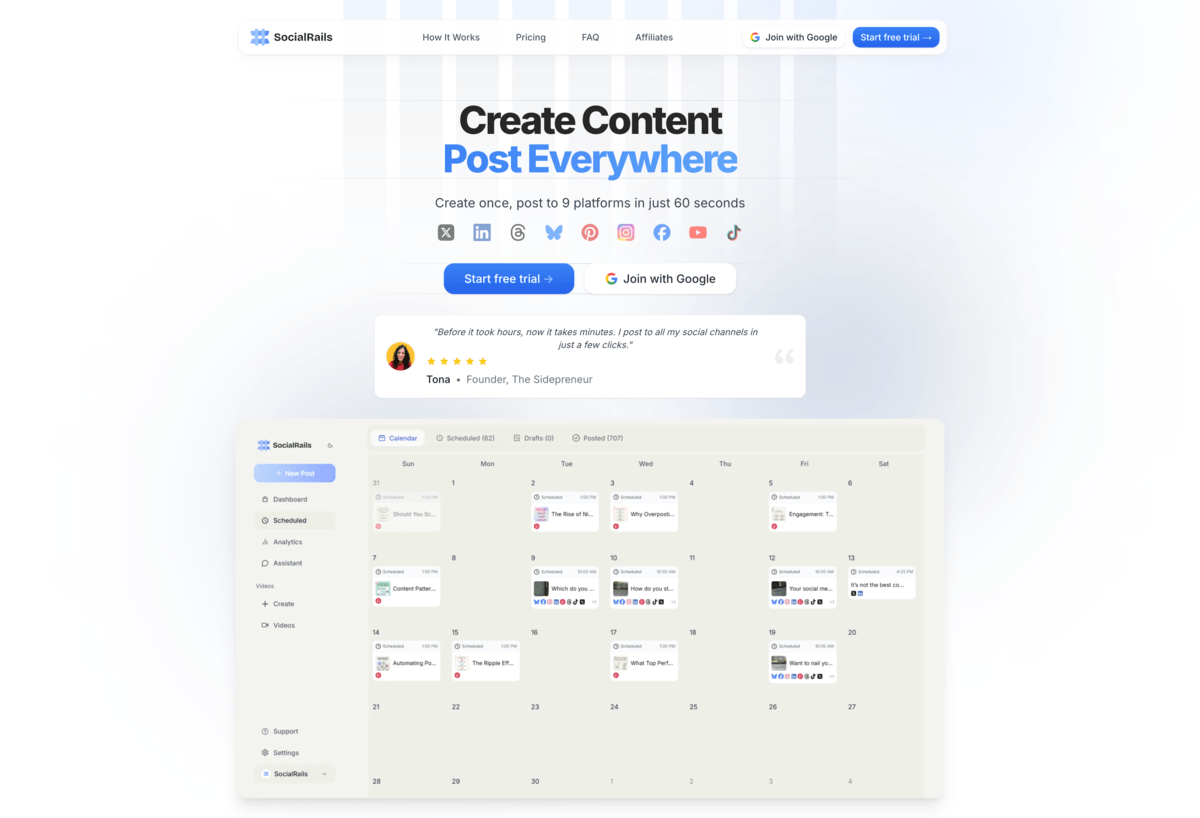
SocialRails is a social media management tool built for small businesses, solo creators, and agencies who want to manage scheduling and content creation without switching between multiple tools.
Some standout features of SocialRails include post scheduling across 9 platforms, built-in AI content generation, an image editor with crop, filters, frames and annotations, 350+ video templates, and multi-workspace support for up to 25 brands.
Pricing: Starts at $29 per month with a 3-day free trial available.
FAQs
Why is social media an important part of inbound marketing?
Social media plays a pivotal role in inbound marketing because it facilitates direct engagement with potential customers. Platforms, like X and Instagram, allow brands to share valuable content, answer queries, and foster relationships. This two-way interaction not only attracts and educates customers but also nurtures and converts them into loyal advocates, seamlessly merging with the inbound methodology of attracting, engaging, and delighting customers.
How to become a social media marketer?
To become a social media marketer, you must work on your creative, analytical, and communication skills. You can start by getting used to popular social platforms to understand user behavior. Then, study the basics of content creation and data analytics. You can take online courses, attend workshops, and seek mentorship. Also, hands-on experience, such as managing a personal brand or volunteering for a small business, is invaluable.
How to market yourself on social media?
Marketing yourself on social media entails building a strong personal brand. Start by determining your niche and creating quality content consistently that resonates with your target audience. Use a social media monitoring platform to monitor your personal brand mentions and join relevant conversations. Optimize your profiles with professional photos, and clear descriptions. Finally, collaborate with like-minded people or brands for wider reach.
What are the best social media marketing courses?
Some top social media marketing courses include HubSpot’s Social Media Certification, Coursera’s Social Media Marketing Specialization, and Udemy’s Complete Social Media Marketing Masterclass. LinkedIn Learning also offers courses by industry experts.
What are the best social media marketing books?
Several books offer in-depth insights into social media marketing. Some acclaimed titles include “Jab, Jab, Jab, Right Hook” by Gary Vaynerchuk, “The Art of Social Media: Power Tips for Power Users” by Guy Kawasaki and Peg Fitzpatrick, and “Influence: The Psychology of Persuasion” by Robert B. Cialdini.
What is the difference between digital marketing and social media marketing?
Digital marketing is a broad business term encompassing all online marketing efforts, including search engine optimization, pay-per-click advertising, email marketing, and more. On the other hand, as a social media marketing definition we can say that it’s a subset of digital marketing that specifically focuses on creating and executing strategies for platforms like TikTok, Instagram, and LinkedIn. While social marketing is a component of digital marketing, the latter includes various other online channels and strategies.